
How Book Publishing Could Help the Guitar Industry
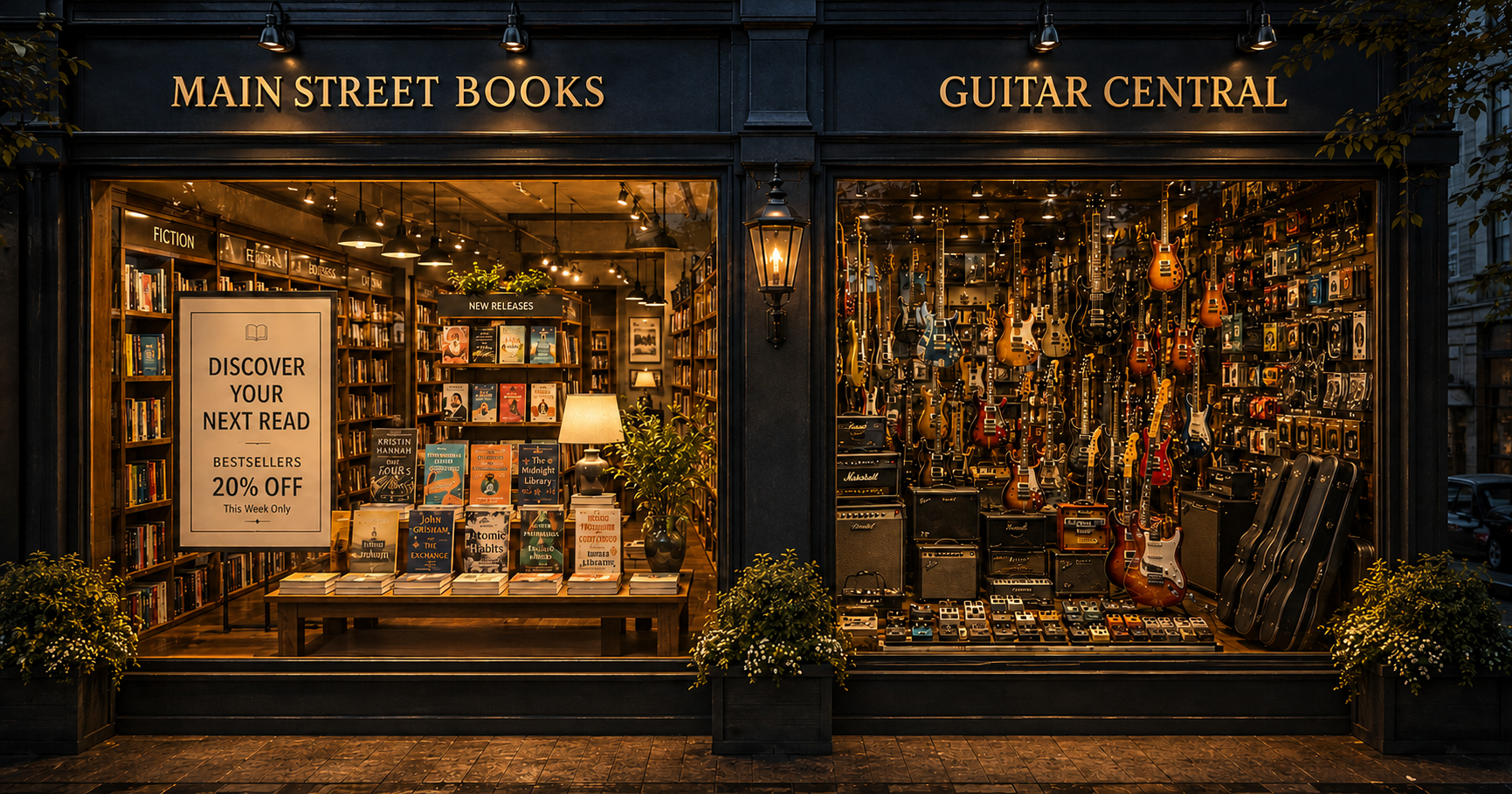
I've been a guitar player for 35 years and doing marketing for 25. These two halves of my brain don't usually intersect, but lately they’ve been doing nothing but.
I spent the first 15 years of my marketing career in publishing — somehow managing to work on 11 New York Times bestsellers (four made it to #1), led and substantially grew the Curious George franchise at Houghton Mifflin Harcourt, and took Sandra Boynton's Dog Train to RIAA Gold (yes, a book that won a Gold Record). After that I got proper training and a full-stack digital marketing certification from one of the top tech schools in the country, and spent the next decade growing e-commerce and digital media brands — audience targeting, paid social, SEO, search, email, landing pages, funnels, and the tracking and conversion strategy that ties it all together. Between the two, I've spent a lot of time thinking about how customers actually move through both the in-store and digital sides of a buying decision.
The guitar industry is bigger than it's ever been. More builders, more brands, more competition across every category — flagship companies, boutique luthiers, pickup makers, amp builders, modeling and IR companies, pedal designers, accessory brands, restoration and refinishing specialists, lesson platforms, retailers of every size. Every corner of this industry is more crowded than it used to be. And one thing I keep hearing is that even brands with serious craft and great products are having a harder time than they should breaking through.
The standard approach looks similar across the categories: chase whatever trend is moving on social media, try to sponsor the next breakout artist, pump out one press release after another. None of that is wrong on its face. A good press release matters. Social done well matters. Artist sponsorships and events can be powerful when they're connected to systems that turn the attention they generate into customers.
But run without that follow-up layer, even the best of those moves end up as short-lived spikes. A press release with no system to capture and follow up with the readers it attracts. A trend chase with no plan to turn attention into a list, a lead, or a sale. An artist activation that peaks at the post and disappears.
I've been turning over a thought for a while: there's a strategy for breaking out of a crowded creative industry that's been refined over decades in another one I know well. And it would map onto the guitar world almost too cleanly.
Book publishing and the guitar industry are playing the same game
Books and guitars look like completely different businesses. The mechanics underneath them aren't. Both industries push a constant flood of new releases into a finite amount of physical shelf space. Both depend on small networks of independent retailers — the people behind the counter who actually hand-sell to customers — to shape what readers and players discover, while a handful of chains and online giants handle most of the transactions. And both serve customers who research obsessively before they commit: the book buyer who reads a dozen blogger videos, reads the Publisher’s Weekly review, and listens to a podcast interview before buying a $30 hardcover is the same profile as the player watching YouTube demos until 2am, reading guitar magazine reviews, and scrolling The Gear Page for hours before they'll spend their hard-earned cash on a guitar.
There's a more specific parallel worth naming. In publishing, even as commerce has shifted heavily to chains and Amazon, indie bookstores stayed disproportionately important as taste-making channels — the places where reputations actually form. From where I'm sitting, guitar retail looks like it might run the same way. The chains and online retailers handle most of the transactions, but the shops where staff plays everything they sell seem to be where opinions get shaped and word spreads. If that's true, the question of how brands and retailers work together gets a lot more interesting than it might first appear.
Customers slipping through the cracks
Only a small fraction of e-commerce visitors buy on their first visit — typical conversion rates run 2-3%. And organic reach on social media really low by design — it’s pay-to-play these days if you want your posts seen, even by your own followers, much less by new players. Only 2-5% of your audience will see any non-paid Facebook post, with very similar numbers on Instagram and YouTube. Which means the vast majority of the players a brand spends real money getting in front of — through ads, content, events, PR, anything — never raise their hand, never get on a list, never come back. They just slip through the cracks.
The bigger e-commerce industries and online retailers solved this problem over a decade ago. The basic idea is to track your anonymous traffic (digital and in-store), then reach back out to those visitors over time — through ads across social media and search, get more people on your email list, then send follow-up email sequences based on product interest and where they’re at in their buying decision. Studies prove it works, and turns a lot more one-time visitors into long-term customers.
A lot of guitar brands and shops haven't fully built that layer yet, and it’s a huge opportunity. The tools are there to turn the traditional marketing channels you’re already using into automated audience and revenue growth systems. Coordinated, synchronized campaigns that build momentum over time, not individual tactics that generate spikes of interest, but don’t drive sales in a measurable or long-term way.
The marketing campaign that happens before a product launches
At my first serious job in NYC, I reported directly to Peter Workman and his daughter Katie. Peter is a legend in the book world, and it’s because he absolutely refused to compromise on quality. He reviewed every single piece of marketing creative in person, 3-dimensionally mocked up, and everything went through about a dozen rounds of changes before it went out the door. He was perpetually disheveled, tie half-undone, salt-and-pepper hair that looked like a mop, and brilliant in a way that could be intimidating and magnetic at the same time. His compliments could make your week. His critiques could rip you to shreds. Two years of being measured against that standard taught me more than the rest of my career combined.
He also had the entire marketing team unwrap hundreds of Hershey bars one by one, then rewrap them with custom printed labels and called them the "Workman Backlist Bar." They were handed out by reps and mailed to accounts nationwide. Slipped under each wrapper was a literal scratch-off card showing the bookseller which discount tier they'd unlocked. Every ticket was a winner. And hidden in five of those bars were "golden tickets," Willy Wonka-style — the bookseller who found one got Workman's deepest backlist terms for a lifetime.
Consumers never saw the backlist bars — they weren’t the audience. The store owners placing the orders were — the ones who decide what gets featured, who hand-sells what, who shapes what a customer actually encounters when they walk in. Getting a retailer genuinely excited about your product, giving their staff a reason to recommend it, building a real relationship with the people who control your shelf space — that's a whole separate marketing job, and it happens weeks or months before any consumer campaign starts. Publishers call the trade campaign before the consumer campaign. Whatever you call it, it's roughly half the work in that industry. By the time a customer walks into a store and sees their key products table near the main entrance, a lot of marketing already happened to decide what gets featured in high-traffic areas.
From the outside, it doesn't look like there's much of this kind of activity flowing toward guitar dealers from the brand side right now. Not because anyone is doing anything wrong — most guitar shops are run by players and luthiers and lifers who love the instrument, not merchandising programs. But the trade-marketing infrastructure that publishers take for granted — POS materials for new releases, staff briefings, in-store contests, retailer incentive programs — looks like something that hasn't fully been built here yet, not something that's been built and abandoned. That reads as opportunity, not failure.
There's a related conversation happening across a lot of smaller brands right now: whether to skip retail altogether and sell direct-to-consumer instead — keep more margin, control the experience, cut out the middleman. It's a reasonable instinct, and for a handful of brands it's worked. But going direct doesn't eliminate the marketing work; it just relocates it. The brands that have actually pulled off a meaningful direct business — the ones with YouTube channels in the hundreds of thousands and years of content behind them — built that audience long before they had the leverage to go direct. For everyone else, retail is still where most of the game gets played. Which makes the near-absence of real dealer support all the more worth paying attention to.
Retail activation is just the starting point
Years ago at Workman, we built a summer promotion around a series of grilling books by the BBQ expert and cooking show personality Steven Raichlen. The centerpiece was a working mini tabletop grill that held a pre-selected assortment of Raichlen's BBQ titles, with custom branded signage carrying a URL. To get the display, bookstores had to take a 24-copy assortment: 12 in the grill, 12 as a refill behind the counter.
The unit margin was negative by design. The required refill recovered some of the loss up front, but the bigger play was longer-term. The grill was permanent — counter or endcap real estate that would sit there for years. Every customer walking past it encountered Raichlen's books and the URL on the signage, which led to a landing page offering a free branded meat thermometer with proof of purchase. The display did the merchandising. The CTA did the audience capture. Peter wasn't buying a promotion. He was buying retail real estate that would compound over time. Sourcing, kitting, and shipping working tabletop grills alongside cartons of books to hundreds of accounts was a logistical mess, and most of us were too deep in the operational complexity to fully see what he was building. He was several moves ahead.
And the grill wasn't a one-off. A few years later, I worked with Peter and the sales team on a permanent acrylic display program for Workman's Brain Quest line — same mechanic, margin loss on the initial sell-in, lifetime discount terms for shops that took a pre-packed display. The display had an attached sample deck so kids could try Brain Quest on the spot, and a front slot holding a full-color shelf-talker we could refresh every season. That swappable shelf-talker meant we had a reason to ship stores new materials several times a year — fresh CTA, new order forms, updated brochures, every refresh a built-in reorder opportunity. Each shelf-talker carried a URL pointing to a landing page where customers could enter a giveaway or sign up for the Brain Quest newsletter in exchange for something useful. The program drove a 30% sales lift across hundreds of independents, the Borders chain, and a larger spinning floor version at Barnes & Noble — and kept stores reordering for years.
I'm seeing more brand installations in bigger guitar shops now, which is great to see. A natural next step could be making those installations more interactive for players — adding elements that help them learn about the products they're looking at without depending entirely on store staff. That helps the store close the sale, drives traffic back to the brand's site, and gives the brand a way to capture engaged players and learn which stores are generating the most interest. Every piece of gear in a display could have its own QR code pointing to a model-specific landing page — specs, demos, dealer bundles, or a branded giveaway tied to that exact product. Players self-identify. Email lists grow. The brand learns who showed up at which dealer, scanned which model, and didn't convert in-store. Three days later, the right follow-up reaches them, and retargeting keeps the brand in front of them until they buy.
This isn't about competing with dealers on the sale. The dealer still owns that transaction. It's about engaging the player who's already in the room and building a relationship beyond the moment they happened to be standing there. Even brands that don't sell direct have everything to gain from an owned email list of engaged players — audience the brand never has to rent.
The same thinking could extend beyond product displays. Most shops host events — clinics, artist visits, lesson programs, local meetups. A brand with permanent branding in a partner dealer's event space would be earning impressions and capture opportunities from every event the store runs, not just the ones the brand sponsors. Same fixture cost. Multiplicatively more output.
The permanent fixture isn't the marketing program. It's the infrastructure the marketing program runs on top of for years.
One campaign, five audiences
A few years into my time at Houghton Mifflin Harcourt, I worked on a Curious George partnership with First Book — the nonprofit that gets new books into the hands of kids in under-resourced communities. The mechanic was simple: a passport-style activation where every stamp earned by a player triggered a book donation, with a 50,000 book minimum guarantee.
That single campaign activated five audiences at once. Consumers had a reason to participate. Retailers had a real reason to dedicate floor space, because foot traffic and brand-positive press came with it. Educators had curriculum-aligned events to plug into. Media had a substantive philanthropic story to cover beyond product. And First Book got fundraising lift along with brand alignment to one of the biggest kids' franchises in the world. Five audiences. One mechanic. Compounding returns across each one.
That's the architecture move most marketing campaigns leave on the table. A Meta ad targets consumers. A dealer email targets retailers. A press release targets media. Each touchpoint operates independently, and the brand spends three or four times the energy to engage three or four audiences than it would have if a single well-designed campaign had done all the jobs at once.
I could imagine a guitar brand running an original-song contest with a $25,000 grand prize, open to any player using the brand's gear in the recording. Submissions go through dealer-tagged links — each dealer gets a unique URL, and a portion of the prize pool flows back as bonuses to dealers whose customers submit the most entries. A portion of proceeds funds music education in under-resourced schools. Players have a reason to buy the gear. Dealers have skin in the game. Media has a philanthropic story. YouTube creators have new content to showcase. And the brand walks away with a new list of interested, engaged players, dealer-attribution data, real press, and original recordings featuring their products that fuels social media for months.
None of this works without a real reason for someone to care. Andy Wood put it bluntly in a recent conversation I had with him: "Never forget that the artist endorses the gear, not the other way around. Just because a company gives you a discount or free gear—or even puts you on their website—that doesn't mean that the general listener will be invested in you and your music. Inversely, if you put out killer stuff that connects with the target audience or general public, then everyone will care about the tools you used to make the art." That's a working artist saying out loud something I've watched play out in publishing for years: an endorsement isn't a substitute for demand. It's confirmation of demand that already exists.
The contest gives players a reason. The dealer kickback gives stores a reason. The cause partner gives media a reason. The brand isn't asking anyone to care about the brand for its own sake. It's giving every audience a reason that matters to them, and letting the brand benefit as a side effect.
What this could mean for guitar industry brands
The pattern that connects every story here is one idea: in publishing, the brands that won in the most crowded years were the ones that built infrastructure, not the ones that spiked attention. Permanent retail fixtures, recurring communication channels, multi-audience activation, tracking and follow-up, trade-marketing programs that compounded over time. Everything was designed to keep working long after launch week ended.
A lot of marketing in the guitar world looks more like the opposite from where I'm sitting — campaigns that spike and then go quiet, promo items that get tossed, displays that get recycled, brand-dealer relationships that, at least from the outside, look mostly transactional. Some of that is the inheritance of an industry built by people who care about the craft first. Some of it is just that nobody's been running this play here yet.
Maybe there's a reason this approach doesn't translate cleanly that I haven't figured out yet. Maybe the economics of guitar products are different enough from book publishing that some of these tactics fall flat. I don't know yet.
But one thing all those years in publishing taught me is that you have to take chances if you want to stand out in a crowded market. Legendary publishing houses refined their approach over decades, and I’ve seen how these strategies can make a serious impact on both retail and DTC sales. With so much great gear to choose from, attention spans shrinking, and all the distractions of social media, guitar and gear brands have to use every tool at their disposal to capture players’ attention, and keep it long-term. Hopefully this sparks some new ideas.
